

Guide
What goes on a produce case label: The PTI label, part by part.
The Produce Traceability Initiative’s case label puts the product, the lot and a barcode in the same places on every case, so any buyer can read and scan it. Here’s each part, on a real label.
For growers, packers and repackers who label cases
The short answer
A PTI case label is the U.S. produce industry’s common format for labeling cases. It has a GS1-128 barcode holding the case’s GTIN, its lot and a pack, harvest or best-if-used-by date, the same numbers printed under the bars, and a four-digit voice pick code in the lower right corner. Around them go the product and variety, the size and pack, the date, where it was grown, who packed it, and the UPC or PLU of what’s inside. PTI is voluntary, and the FDA’s traceability rule doesn’t require the traceability lot code on food labels or packaging (FDA FAQ TTLC.3). PTI designed the label to meet buyers’ requirements in the U.S. and Canada.
A PTI case label, part by part
This 4×3 inch label was printed by Clovero, with a made-up company, product numbers and lot. The parts are numbered from the top down, then along the bottom row from left to right.
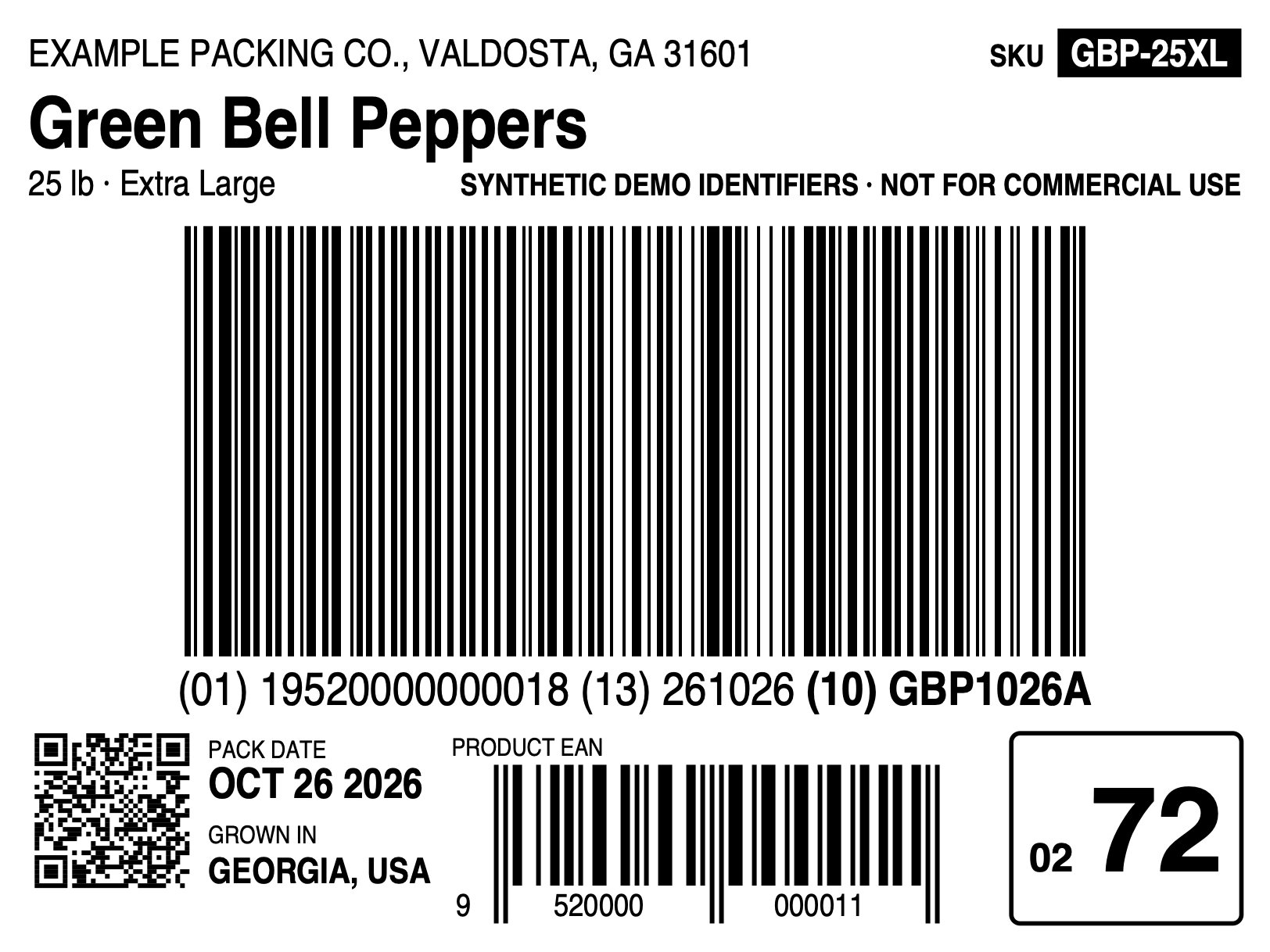
- Who packed it. Top left: the company responsible for the product, with its city, state and ZIP. PTI calls it the responsible party.
- Your item number. Top right: a SKU. It isn’t part of PTI’s label; add one if your buyers use it.
- Product and variety. The largest text on the label.
- Size and pack. Such as 25 lb, Extra Large, or 12 × 1 lb bags.
- The GS1-128 barcode. The case’s GTIN, its lot and a date. The next section shows what goes in it.
- The same numbers in text. Directly under the bars, so a person can read what the scanner reads. PTI suggests putting the lot on a line of its own when there’s room.
- A QR code. Bottom left: the same data as a GS1 Digital Link, which phones and 2D scanners read. It isn’t part of PTI’s label.
- The date. A harvest, pack or best-if-used-by date, whichever your buyers want. It should match the date on the items inside.
- Grown in. For produce from the U.S. or Canada, the state or province and the country; for anywhere else, the country. Romaine uses growing regions such as Salinas or Yuma, and a mixed case starts with “Multiple”.
- The retail barcode or PLU. The UPC of the packages inside for a case of prepacks, or the PLU number for a case of loose produce: whichever the items carry, or both if they carry both. This example shows an EAN-13; U.S. packages usually carry a UPC-A.
- The voice pick code. Bottom right: four digits worked out from the barcode’s data, with the last two printed large.
PTI’s label also has room for a grade where one is required. It includes French for cases going to Canada; a label for cases that stay in the U.S. can leave the French off.
What goes in the barcode
The barcode is a GS1-128, the linear barcode used on cases and pallets. Each piece of data starts with a GS1 Application Identifier, the number in parentheses, which says what follows. PTI’s best practice puts the GTIN, the lot and one date in it.
| Identifier | What it holds | Format | On the example |
|---|---|---|---|
| (01) | The case’s GTIN | 14 digits | 19520000000018 |
| (10) | Batch or lot number | Up to 20 characters | GBP1026A |
| (13) | Pack or harvest date | YYMMDD | 261026 |
| (15) | Best-if-used-by date | YYMMDD | Not used; the example has a pack date |
Use a pack or harvest date (13) or a best-if-used-by date (15), the same kind of date the label shows. If a lot ever spans more than one pack date, PTI says the date belongs in the barcode.
Lot codes that scan cleanly
- Up to 20 characters. PTI rules out some characters, including #, @, ^, ~, backslashes, brackets, braces and spaces.
- Upper case. Lot codes are case sensitive, so PTI recommends upper-case letters to avoid confusion.
- The lot your records use. Retyping it into a separate label program is how the code on the case and the code in your records drift apart.
- Unique under a private label. When several packers pack one brand owner’s GTIN, the brand owner should make sure no two of them use the same lot.
How the voice pick code is worked out
The voice pick code lets a picker using a voice picking system confirm a case by saying four digits instead of a 14-digit GTIN and a lot. PTI’s method:
- Write the data as one string: the GTIN’s 14 digits, then the lot, then the date as YYMMDD if the barcode carries one. No parentheses, identifiers or spaces.
- Take its ANSI CRC-16 (the polynomial x¹⁶ + x¹⁵ + x² + 1).
- Keep the last four digits of the result in decimal.
- Print the first two small and the last two large.
In PTI’s worked example, GTIN 10850510002011 and lot 46587443HG234 give a CRC-16 of 26359, so the code is 6359: a small 63 and a large 59. On the label above, 19520000000018, GBP1026A and 261026 give 0272. The lot is case sensitive, so the code is too. PTI’s website has a calculator for checking yours.
Barcode size and placement
| Scanning | Narrowest bar | Minimum height |
|---|---|---|
| Handheld scanners, with a person | 9.84 to 30 mils (0.25 to 0.75 mm) | 0.5 in (12.7 mm) |
| Fixed scanners on a conveyor | 19.5 to 40 mils (0.495 to 1.016 mm) | 1.25 in (32 mm) |
Either way, the barcode can be at most 6.5 inches wide, including a quiet zone of 10 times the narrowest bar on each side. Print quality should grade 1.5 or better under ISO/IEC 15416, checked with a barcode verifier.
- On the side of the case, with the bars upright.
- About 1.25 inches up: the bottom of the barcode that far above the base of the case.
- Clear of the edges: the barcode and its quiet zones at least 0.75 inches from any vertical edge.
- At least one per case. PTI recommends two when labels are pre-printed rather than printed on demand.
PTI accepts that some packaging, such as some RPCs and bags, can’t follow this, and gives options for short cases and trays.
Common case label mistakes
- The lot on the case isn’t the lot in your records. Print labels from the lot record instead of retyping the code.
- The barcode is too small or too short for how your buyer scans. Check it against the sizes above.
- The quiet zone is cut off by the label’s edge or other printing, so scanners can’t find where the barcode starts.
- The date on the case doesn’t match the date on the items inside.
- Faint or streaky bars from a worn printhead or the wrong darkness setting. A verifier catches them before your buyer does.
- The label wraps around a corner or sits too close to an edge, and gets scuffed in transit.
Is a PTI label required?
Not by law. PTI is a voluntary U.S. produce initiative, and GS1 standards are voluntary. Trading partners can agree to vary PTI’s recommendations as long as the minimum traceability information is there, and PTI asks suppliers to tell their partners about any variations. Your buyers can still make a PTI label a condition of doing business.
FSMA 204 doesn’t require one either. The FDA says the rule doesn’t require the traceability lot code on food labeling or packaging; it can travel on a bill of lading, an ASN, an email or a QR code (FAQ TTLC.3). Barcode scanning isn’t required (FAQ TI.12), though the FDA says GS1 standards can support compliance (FAQ TPTS.3). As of October 26, 2026, the FDA is subject to a congressional direction not to enforce the rule before July 20, 2028. Read the FSMA 204 guide
How Clovero helps
Clovero prints PTI case labels from the lot itself, so the code on the case is the code in your records; the label above came out of Clovero. It sizes the barcode to PTI’s minimums for 203 dpi thermal label printers and shows whether it suits handheld or conveyor scanners, works out the voice pick code, and adds your SKU, plus the retail UPC or EAN barcode and a GS1 Digital Link QR on 4×3 labels and larger. Putting the pack date in the barcode is a setting. It doesn’t print PLU numbers, a grade, a best-if-used-by date or French text yet.
Pallets get a label of their own. A basic pallet label puts the product and lot code in big print, with a QR code to the lot. Or give each pallet of a lot its own number and a 4×6 label with the lot and pack date (no case count, since cases get pulled from pallets), so your crew can scan a pallet and see which lot it holds. The number is an internal pallet ID unless you add a GS1 Company Prefix for customers who ask for SSCCs. See case and pallet labels in Clovero
This guide is a summary of PTI’s published guidance as of the date above, not legal advice. Your buyers’ label requirements may differ, and labels can also be subject to other rules, such as state, country-of-origin and Canadian requirements, which this guide doesn’t cover.
Sources
- Produce Traceability Initiative: Best Practices for Formatting Case Labels (Revision 2.3, November 2024) The barcode, sizes, placement, lot characters and voice pick code.
- Produce Traceability Initiative: Case Label & Data Elements for Industry Use (v. 2.0, November 2024) The common label’s parts and font sizes.
- Produce Traceability Initiative: Voice pick code calculator
- FDA: Frequently Asked Questions on the Food Traceability Rule Answers cited by their FDA numbers, such as TT.2.
- GS1 US: What is a GS1-128 barcode?
- Public Law 119-37, Division B, Section 780 (November 12, 2025) Congress’s direction not to enforce the rule before July 20, 2028.
Keep reading.
Produce repacking traceability
Track the lots that go into a repack and the lot that comes out, with examples.
Open (Produce repacking traceability)Supplier didn’t send a lot code?
What to check, who to ask, and why your own receiving number isn’t a lot code.
Open (Supplier didn’t send a lot code?)FSMA 204 for produce, in plain English
Who the FDA’s traceability rule covers, what to record and when it applies.
Open (FSMA 204 for produce, in plain English)
Bring one case. We’ll print its label.
Bring a product and a lot you pack. We’ll print its PTI case label with you in Clovero.
Get a demo